It seems like every town in America has a food bank. We think of them as longstanding institutions, as a fundamental part of our community\'s charitable machinery. But in fact, the first food bank in the world opened in Phoenix, Arizona, just 25 years ago. It was dreamed up by a man who collected donation jars for a local mission; a resourceful Latina mother came up with the name.
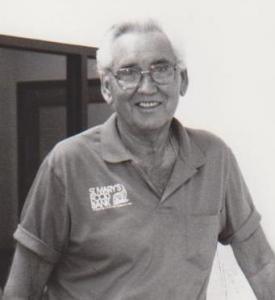
John Van Hengel, the jar collector, was once on the fast track. He had a great job and a social life that just wouldn’t quit. A 1950â€s party animal, he hung out at beaches and tennis courts with the rich and famous. When his marriage broke up, he chucked it all. After a few years of working and living rough, he found himself in Arizona. He took a small job at a mission and made friends there. To help the mission kitchen, he began to travel around the area in an old milk truck, gleaning excess citrus fruit from homeowners and farmers in the surrounding valley. He convinced some of the other guys who hung around the mission to help him out in exchange for free meals. His crew was soon harvesting so much produce the he began supplying other charity kitchens too.
Van Hengel discovered that there just weren’t enough hours in the day for him to both glean produce and haul it to kitchens all over the city. He was on the road until after 9:00 each night; there had to be a better way. As a former businessman he could see the need or a centralized clearinghouse for food collection and storage. “If they want it, they’ll come to us,†he declared. With the donation of an abandoned bakery owned by a church, Van Hengel’s warehouse was in business.
A friend who was a social worker opened the next door for Van Hengel. He insisted the gleaner meet one of his clients, a Latina with no money for food but ten kids who were “healthy as bears.†She showed Van Hengel her secret weapon--the grocery store dumpster. This was his introduction to pull dates, imperfect produce and mystery cans without labels. Van Hengel skipped the garbage bins and went right to the store managers. Soon his free fruit store was offering much more. Searching for a name for his project, Van Hengel was once again inspired by that resourceful mother. She came in with a cartoon she’d drawn of the warehouse building as a bank, with food being deposited through the front doors and happy people making withdrawals from the back. St. Mary’s Food Bank, the first in the world, was born. That year it distributed a quarter million pounds of food to 36 Phoenix charities.
The food bank grew as Van Hengel discovered new sources of good food—grocers, gleaners, trades, and in one case, a sympathetic judge who imposed a fine of 539,000 gallons of milk on a group of dairies found guilty of price=fixing. This started Van Hengel thinking about surpluses and imperfect foods that might be available from manufacturers. Donations to food banks would not only solve disposal problems for the companies, but it would also earn them a tax break.
One of the first national items Van Hengel was offered was 75,000 cases of Miller Beer. “I would have been the number one fraternity man in the United States,†he says, “but I had to turn them down. Practically everybody who worked for me in those days was an alcoholic because about six alcohol-recovery centers worked with us.â€
Van Hengel shared the wealth, helping other communities in Arizona and California start food banks too. In 1976, eager for a new challenge, Van Hengel took the food bank idea national. He founded Second Harvest, to provide information and support to new food banks across the country and to set up a national distribution network for food-industry donations. Van Hengel returned to St. Mary’s Food Bank in 1983, leaving behind a surplus-food network with more than 180 members and affiliates. Now he directs an international clearinghouse for food bank networks around the world, all of them started by people who have taken Van Hengel’s idea and run with it. “I can’t even imagine the number of people being fed by food banks now,†he says. Surprisingly, Van Hengel says he gets the most satisfaction from knowing how many people working as volunteers in food banks are finding that “the fun is in giving.â€
Van Hengel and his volunteers ran St. Mary’s Food Bank without pay for nearly ten years. He’s taken only a minimal salary since. He puts his faith in Matthew 6, which promises God will provide for those who do His work. While Van Hengel counts on the Lord, he also holds up his end of the bargain. Besides his work with food banks, he’s volunteered for the past thirteen years with Alpha Omega, an organization that provides essential transportation for 7,000 senior citizens. The man once affectionately referred to as “The Mother Teresa of Celery†has been able to see his investment of time and energy blossom. Once again he turns to Scripture. “In Matthew 13 the Lord says, ‘If you plant a seed I’ll bless it a hundredfold.’ Well, he certainly went overboard with me.\"
Update: In 1992, John Van Hengel received an America’s Award, which has often been described as “the Nobel Prize for goodness,†at a Kennedy Center ceremony. After a long rift, he reconciled with a reorganized Second Harvest board, which had moved the organization’s headquarters to Chicago. In 2008, Second Harvest was re-named Feeding America. Millions of pounds of good food have been supplied to the hungry, thanks to the canny thinker who devised the food bank system. John Van Hengel died in Phoenix in 2005. Van Hengel’s work goes on at http://feedingamerica.org/
